Why Autumn Works in the Lefka Ori
The White Mountains, or Lefka Ori, cover much of western Crete south of Chania. Their highest summit, Pachnes, reaches 2,453 metres, second only to Mount Ida on the island, and more than thirty peaks rise above 2,000 metres. The name comes from the pale limestone, which looks white even when there is no snow.
In summer the gorges are crowded and the open ground above the tree line is fiercely hot. From October into November the heat eases, the light is clearer and the trails are much quieter, while the sea on the south coast is still warm enough for a swim at the end of a gorge walk. The trade-offs are shorter days, the first autumn storms, and reduced transport once the tourist season winds down.
Samaria Gorge and Its Season
Samaria, inside a national park, is the best-known walk: about 16 kilometres downhill from Xyloskalo on the Omalos plateau to Agia Roumeli on the south coast, which has no road and is left by ferry. The park is normally open from spring to late October, but the season depends on conditions. The gorge closes at short notice after heavy rain because of flash-flood and rockfall risk, and in autumn it can shut early. Entry requires a ticket from the park's official booking service run by NECCA, which also posts closures; check it shortly before you go rather than relying on a fixed date.
If Samaria is closed or you want somewhere quieter, there are many alternatives. The White Mountains contain around fifty gorges.
Imbros, Aradena and Other Gorges
Imbros gorge runs from the village of Imbros on the Askifou plateau down to Komitades near Hora Sfakion. It is shorter and easier than Samaria, generally walkable well beyond the main season, and takes most people two to three hours. Taxis at the bottom can return you to the top.
Aradena gorge, near Anopoli, is steeper and rougher, with some scrambling and a section that can be exposed; it descends to the pebble beach at Marmara, from where a coastal path continues east to Loutro. Agia Irini gorge, starting from the road south of Omalos, is a wooded descent toward Sougia. All of these can become dangerous in heavy rain, so do not enter a gorge when storms are forecast.
The High Mountains
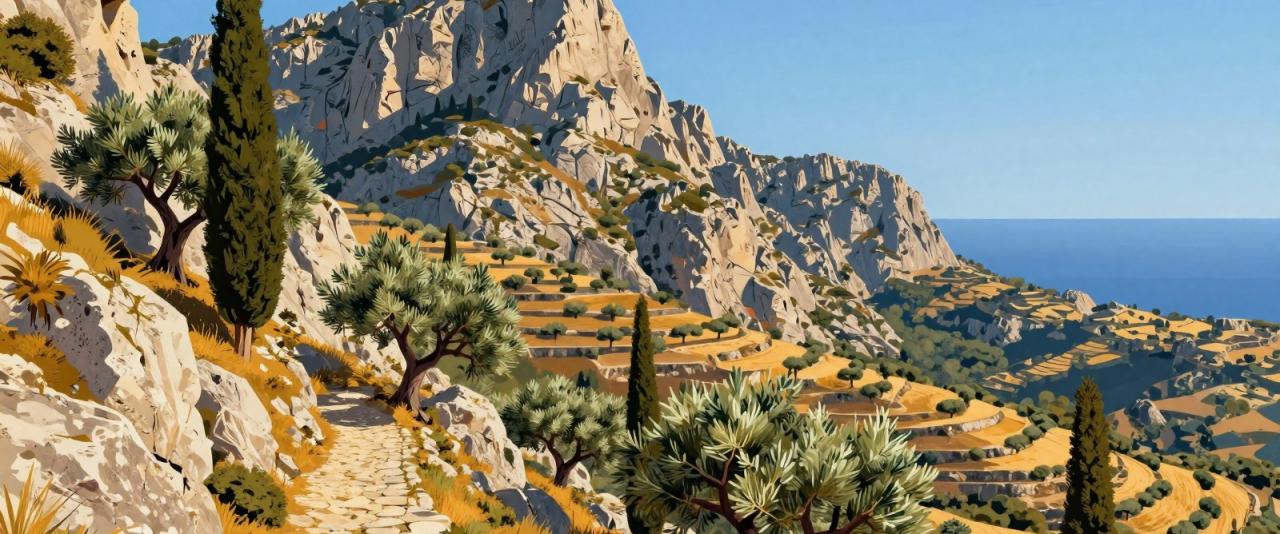
Above about 1,800 metres the White Mountains turn into a high desert of bare limestone, scree and sinkholes, often compared to a lunar landscape. There is no shade or surface water and few landmarks, and cloud can come down quickly. Routes to Pachnes are commonly approached from Anopoli in the south or from the Kallergi refuge above Omalos.
The range has four mountain refuges run by the Hellenic mountaineering clubs: Kallergi at 1,650 metres near Omalos, Volikas, Tavri, and Svourichti at 1,980 metres. Their opening periods vary and some are staffed only in summer, so contact the operating club before planning an overnight stay in autumn. Experienced hikers can use the waymarked E4 European long-distance path, which crosses the range and also follows the south coast between Hora Sfakion, Loutro and Agia Roumeli.
Weather and Daylight
October is usually settled, with occasional storms. November brings more rain, and snow can fall on the high peaks from late autumn and often lingers into late spring. Temperatures in the high mountains drop sharply at night even when the coast is mild. By late October daylight is noticeably shorter, so start early and plan to be off exposed ground and out of gorges well before dark.
Autumn also has its own seasonal detail. After the first rains, autumn-flowering bulbs appear on the hillsides, and the plane trees in gorges and river valleys turn yellow. Hunting season is open in autumn, so wear something bright and expect shooting near villages, especially at weekends.
Logistics and Safety
The south-coast ferry line linking Hora Sfakion, Loutro, Agia Roumeli and Sougia runs a reduced timetable outside summer, and services can be cancelled in rough seas. Check the current schedule before any walk that depends on a boat out, and have a backup plan for a night in Agia Roumeli or Loutro. KTEL buses from Chania to Omalos and Hora Sfakion also thin out after the season.
Carry more water than you think you need, a waterproof layer, a warm layer, a headtorch, and offline maps; mobile signal is patchy in gorges and on the high ground. Tell someone your route. For the high peaks in autumn, going with a local mountain guide is a sensible choice, and in an emergency the Greek number is 112.