Zakynthos is known for Navagio, the shipwreck beach, and for the loggerhead turtles of Laganas Bay. Its town, rebuilt after an earthquake in 1953, is easy to pass through on the way to the beaches. But this is the island whose poet wrote the Greek national anthem, whose bishop and mayor refused to hand over its Jews to the Nazis, and which set aside the first national park in the Mediterranean created to protect sea turtles.
This is Zakynthos's bright side, in roughly the order it happened. Some of its most loved stories come from tradition rather than documents, and we say so where they do. Every chapter ends with something you can go and see.
1622: A Saint Who Forgave
The island's patron saint, Dionysios of Zakynthos, was born here in 1547 and became a monk and later archbishop. The story every islander knows is about forgiveness. A fugitive came to his monastery asking to be hidden. As they talked, Dionysios realised that the man had murdered his own brother. He hid him anyway, did not hand him over, and helped him to repent and escape. It comes from the saint's life as the church tells it, not from a court record, but it is the reason he is loved here.
Dionysios died on 17 December 1622. His relics were brought to the town in 1717 and rest in the church named after him on the harbour.
 An 18th-century engraved icon of Saint Dionysios of Zakynthos. Image: Unknown authorUnknown author, Public domain, via Wikimedia Commons.
 The bell tower of Saint Dionysios on the harbour of Zakynthos town at sunset. Image: salech hcelas, CC BY 3.0, via Wikimedia Commons.
Where to see it today: the Church of Saint Dionysios at the southern end of the harbour, with its tall bell tower and the saint's silver reliquary inside. His feast days, 24 August and 17 December, bring processions through the town.
The Venetian Centuries: The Flower of the Levant
Venice ruled Zakynthos from the late 15th century until 1797, and called it Fior di Levante, the Flower of the Levant. Under Venice the island escaped Ottoman rule, and when Crete fell to the Ottomans in 1669, painters from Crete settled in the Ionian Islands. Here they developed the Heptanese School of painting, which blended Byzantine icon painting with the Western art of Italy. Its leading Zakynthian painters were Nikolaos Koutouzis and his pupil Nikolaos Kantounis.
 Self-portrait of the Zakynthian painter Nikolaos Koutouzis (1741–1813). Image: Nikolaos Koutouzis, Public domain, via Wikimedia Commons.
 Zakynthos town as painted on an icon of 1732, before the earthquake. Image: Nikolaos Kalergis, CC BY-SA 4.0, via Wikimedia Commons.
Where to see it today: the Museum of Zakynthos (the former Byzantine Museum), Solomos Square, with icons and paintings of the Heptanese School and fragments of churches saved from the 1953 earthquake. It is closed on Tuesdays and, in winter, open Wednesday to Saturday.
 The Museum of Zakynthos on Solomos Square. Image: Maesi64, CC0, via Wikimedia Commons.
1778–1798: An Island of Poets
Three of the great poets of the early 19th century were born on Zakynthos within twenty years of each other.
Ugo Foscolo, born here in 1778 to a Venetian father and a Greek mother, became one of the great poets of the Italian language. His sonnet "A Zacinto" is addressed to the island of his childhood. Andreas Kalvos, born in 1792, wrote odes to Greek freedom. And Dionysios Solomos, born on 8 April 1798, became Greece's national poet.
 The house where Ugo Foscolo was born, in an engraving of 1893. Image: Unknown authorUnknown author, CC0, via Wikimedia Commons.
Where to see it today: the monument to Foscolo, topped by a marble angel, in the town.
 The angel on the monument to Ugo Foscolo. Image: ChristosV, CC BY-SA 3.0, via Wikimedia Commons.
1823: The Hymn to Liberty
In May 1823, during the Greek War of Independence, Solomos wrote the Hymn to Liberty, a poem of 158 stanzas. Island tradition says he wrote it on Strani hill, above the town, listening to the guns of the siege of Mesolongi across the water; there is no contemporary record to prove it, but the hill is still visited for that reason. The Corfiot composer Nikolaos Mantzaros set it to music. In the 1860s its first two stanzas became the national anthem of Greece, and in 1966 also of Cyprus.
Solomos died in Corfu in 1857. His remains were brought home to Zakynthos.
 The statue of Dionysios Solomos on Solomos Square. Image: Christaras A, CC BY 3.0, via Wikimedia Commons.
Where to see it today:
- The Museum of Solomos and Eminent Zakynthians, on Agios Markos Square, with his tomb and Kalvos's, manuscripts and portraits. It is open every morning, and in July and August also in the evening.
- Solomos Square, the town's main square on the waterfront, with his statue.
- Strani hill, above the district of Bochali, for the view across to the mainland.
 The Museum of Solomos and Eminent Zakynthians on Agios Markos Square. Image: Maesi64, CC0, via Wikimedia Commons.
1943–1944: The Bishop, the Mayor and the List
In September 1943, after Italy surrendered, German troops took over Zakynthos. About 275 Jews lived on the island, most of them in the town. The German commander ordered the mayor, Loukas Karrer, to give him a list of their names.
Karrer went to the island's Metropolitan bishop, Chrysostomos Dimitriou. On the bishop's advice, the list was never handed over; the paper with the names was burned. The bishop went to the German commander himself and argued that the Jews were Greek citizens who had harmed no one. In the version Yad Vashem tells, he handed over a sheet of paper with only his own name on it and said "Here is the list of Jews you required." Other versions give two names, his and the mayor's. No document survives, and the scene comes from testimony, but the outcome is not in doubt.
The Jews of Zakynthos were warned and went into hiding in the mountain villages, where islanders sheltered them. When German boats came in 1944 to deport them, they could not round them up. Virtually the whole community survived, the only Jewish community in occupied Greece to escape destruction. In 1978 Yad Vashem recognised both the bishop and the mayor as Righteous Among the Nations.
After the war most of the community left for Israel or Athens. The town of Zakynthos is twinned with Kiryat Bialik in Israel.
 Gravestones in the Jewish cemetery of Zakynthos. Image: Nikodem Nijaki, CC BY-SA 3.0, via Wikimedia Commons.
Where to see it today:
- The memorial to the bishop and the mayor, two marble stelae with their portraits, on the site of the old synagogue in the town, put up in 1992 by the Jewish communities of Greece.
- The Jewish cemetery on the hillside behind the church of St George, with gravestones dating from the 17th century.
1953: The Earthquake and the Rescue of a Poet's Papers
On 12 August 1953 an earthquake of magnitude 6.8 struck the Ionian Islands, after two strong foreshocks. Across Kefalonia, Zakynthos and Ithaca, several hundred people were killed. In Zakynthos town, fire followed the earthquake and destroyed almost every building. One of the few that survived was the newly built Church of Saint Dionysios, designed to resist earthquakes, which sheltered people left homeless.
Help came from many countries. American and British warships were the first to arrive. The navy of Israel, five years old, sent four ships to the islands: it was Israel's first disaster-relief mission abroad.
One rescue the island remembers: as the building holding Dionysios Solomos's manuscripts burned, a local man went in and carried them out, with other papers from the island's past. They are in the Solomos Museum today.
The town was rebuilt to earthquake-resistant standards, with arcades and squares that echo its Venetian past. The 16th-century church of Agios Nikolaos tou Molou on Solomos Square was rebuilt from its original stones.
 Zakynthos town around 1895, before the earthquake. Image: Unknown authorUnknown author, Public domain, via Wikimedia Commons.
 The new town rebuilt after the earthquake of 1953. Image: , CC BY 4.0, via Wikimedia Commons.
Where to see it today: compare the two photographs from the hill of Bochali, above the town, where the old Venetian fortress stands.
1984 and 1999: The Turtles
Laganas Bay, in the south of the island, is one of the most important nesting places in the Mediterranean for the loggerhead sea turtle, Caretta caretta. Every summer the females come ashore at night to lay their eggs in the sand.
In 1984 the Greek conservation group ARCHELON began protecting the nests, with volunteers marking them, guarding them and talking to visitors. In December 1999 Greece created the National Marine Park of Zakynthos, covering 135 square kilometres of sea and six nesting beaches. It was the first national park in the Mediterranean created to protect sea turtles. The number of nests varies a lot from year to year, around 1,200 on average; in 2024 there were a record 2,470.
 A loggerhead turtle in Laganas Bay. Image: Funfood, CC BY-SA 3.0, via Wikimedia Commons.
 A protective cage over a turtle nest on a Laganas beach. Image: Edoderoo, CC BY-SA 3.0, via Wikimedia Commons.
Where to see it today: the beaches of Laganas Bay, including Gerakas and Kalamaki. Follow the park's rules: stay off the nesting beaches at night, keep to the zone near the water, and don't disturb marked nests. ARCHELON runs an information station in the summer.
Every Evening: Kantades
The island has its own music: the kantades, serenades sung by small groups of men to guitar or mandolin, shaped by centuries of Italian influence, and the arekia, unaccompanied songs improvised in several voices. You can still hear them in the tavernas of the old town and at carnival time.
How to See Bright Zakynthos
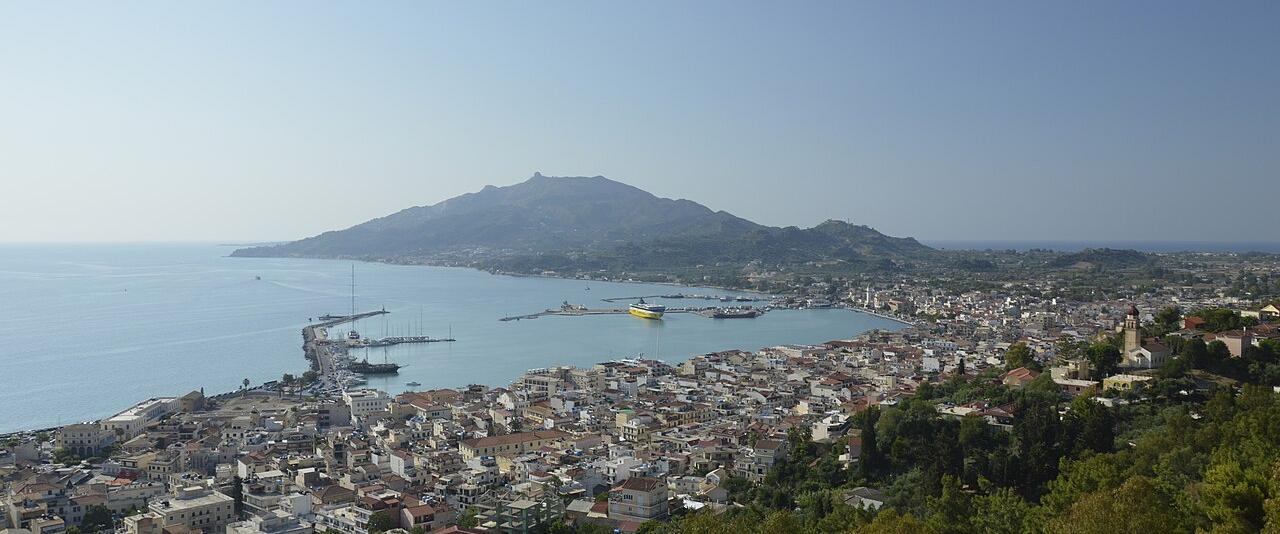
A self-guided walk, about 3 km. Start at the Church of Saint Dionysios on the harbour and walk north along the waterfront to Solomos Square, with the poet's statue, the Museum of Zakynthos and Agios Nikolaos tou Molou. Turn inland to Agios Markos Square and the Solomos Museum, then find the memorial to the bishop and the mayor on the site of the synagogue. Finish by climbing to Bochali for the view over the rebuilt town and across to Strani hill.
Further afield:
- The turtle beaches of Laganas Bay, by day.
- The Jewish cemetery behind St George's.
 Zakynthos town and the harbour from the hills of Bochali. Image: Mrcsifkin, CC BY-SA 3.0, via Wikimedia Commons.
Dates to know:
- 8 April: Solomos's birthday.
- 24 August and 17 December: the feasts of Saint Dionysios.
- 12 August: the anniversary of the 1953 earthquake.
- May to October: the turtle nesting season.