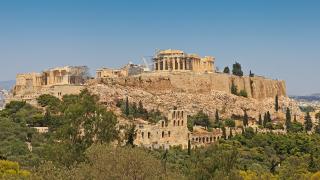
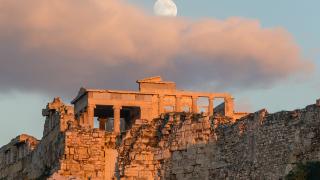
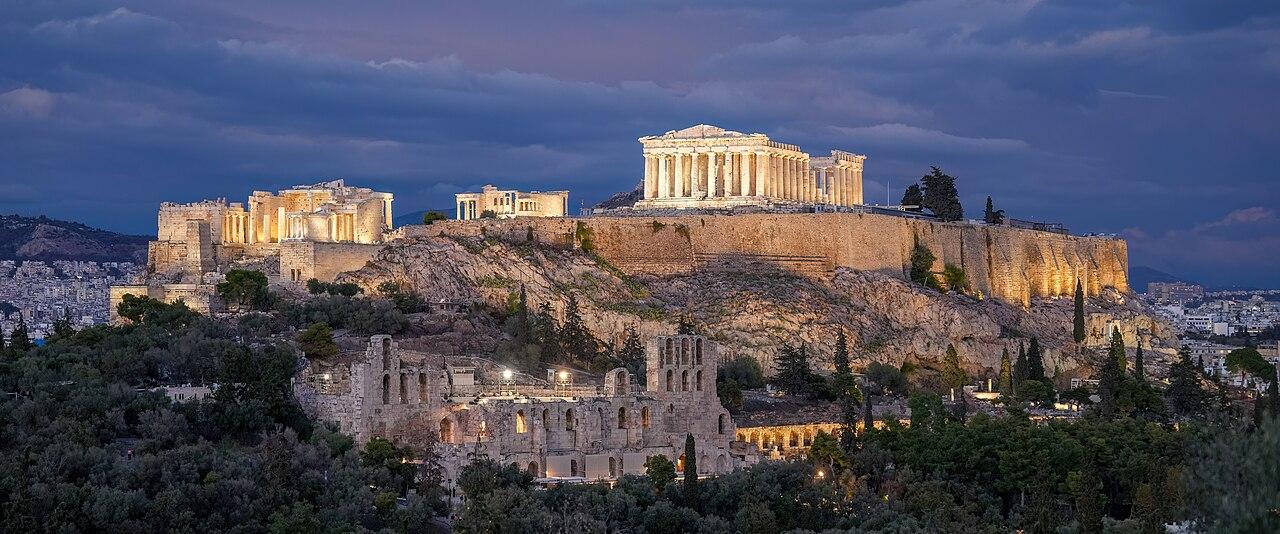
Athens sells itself as the birthplace of democracy: the Parthenon lit gold at night, philosophers in the Agora, tavernas under the Acropolis. The same city sentenced Socrates to death by a show of votes, threw criminals into a pit, lost a quarter of its people to plague, and watched its greatest temple blow up in a siege. In the 20th century it starved under occupation, fought a civil war in its own streets and lived for seven years under a military dictatorship that tortured its opponents a few blocks from Syntagma.
Most of these chapters left something you can still find: a cell door in a basement, bullet holes on a corner of Amalias Avenue, a bent iron gate. This guide goes through them in order, from 430 BC to the present, and tells you where to see each one. Several places have only recently been opened, or reopened, to visitors, so check before you go.
430 BC: Plague in the City
In the second year of the Peloponnesian War, with the whole population of Attica crowded inside the city walls, Athens was struck by an epidemic. It came in waves, in 430, 429 and the winter of 427–426 BC, and killed an estimated 75,000 to 100,000 people, perhaps a quarter of the population. The historian Thucydides, who caught it and survived, described bodies piled in the temples and people dying in the streets. Pericles, the city's leading statesman, died in 429, according to Plutarch of the plague.
In the 1990s, workers building the Kerameikos metro station found a mass grave from those years: the remains of about 90 people, including children, thrown into a pit together, with perhaps 150 buried there originally. A DNA study suggested the disease may have been typhoid, though that remains disputed. The pit itself was removed during construction.
Where to see it today: the Kerameikos, Athens' ancient cemetery at Ermou 148, reopened with its museum in September 2026 after a long upgrade. The plague grave is gone, but the Street of Tombs gives a sense of how the city buried its dead.
399 BC: The Death of Socrates
In 399 BC the philosopher Socrates was tried before a jury of ordinary citizens, usually put at 501, on charges of impiety and corrupting the young. He was found guilty by about 280 votes to 221; Plato wrote that had 30 votes gone the other way he would have been acquitted. Sentenced to death, he drank poison in the state prison, surrounded by his friends. Plato only calls it "the drug"; that it was hemlock is the traditional account.
 Jacques-Louis David's The Death of Socrates (1787). Image: Jacques-Louis David, Public domain, via Wikimedia Commons.
Where to see it today: on Filopappou Hill a set of rock-cut chambers with barred openings is signposted as the "Prison of Socrates". The attribution is late and not credible. Most archaeologists place the real prison in a building about 100 metres outside the south-west corner of the Ancient Agora, where small clay vessels that may have held the poison were found; a marble statuette fragment from there, possibly of Socrates, is in the Agora Museum. The Filopappou caves have a better story of their own: in 1940–41 they were used to hide antiquities from the National Archaeological Museum and the Acropolis, sealed with concrete before the Germans arrived.
 The rock-cut chambers on Filopappou Hill sold as the "Prison of Socrates". Image: Jakub Hałun, CC BY 4.0, via Wikimedia Commons.
The Pit and the Plank
Classical Athens had its own forms of execution. Condemned criminals could be thrown into the Barathron, a pit or chasm west of the Pnyx, where Athenians also gathered to vote; no one has found the exact spot. Another punishment, apotympanismos, clamped the condemned to a wooden plank to die slowly.
At Phaleron, on the coast south of the centre, excavators in 2016 found the skeletons of about 80 men, 36 of them with iron shackles still on their wrists, one trench holding 16 men chained together. They date from between the late 7th and the 5th century BC. One theory links them to the failed coup of Cylon around 632 BC, but that remains a hypothesis.
Where to see it today: a small exhibit about the Phaleron burials is at the Stavros Niarchos Foundation Cultural Center. A permanent museum over the site has been announced but has no opening date.
1687: The Parthenon Explodes
For more than two thousand years the Parthenon stood almost complete. It had been a temple, a church and a mosque. In September 1687, during a war between Venice and the Ottoman Empire, a Venetian army under Francesco Morosini besieged the Ottoman garrison on the Acropolis. The defenders were using the Parthenon as a gunpowder store.
On the evening of 26 September a Venetian mortar shell hit it. The explosion killed about 300 people, blew out the roof and brought down most of the walls; Morosini reported it as a "fortunate shot". When the Venetians tried to remove the sculptures from the west pediment the next spring, the figures of Poseidon and Athena's horses fell and smashed.
 The Venetian bombardment of the Acropolis in September 1687, from Francesco Fanelli's view of Athens (1695). Image: Francesco Fanelli, Public domain, via Wikimedia Commons.
Where to see it today: the gap in the middle of the Parthenon's long sides is the blast. Look at it from the Acropolis itself or, better, from the top floor of the Acropolis Museum.
1801–1812: The Marbles
Between 1801 and 1812, agents of the British ambassador Lord Elgin removed about half of the surviving sculpture of the Parthenon and shipped it to Britain, under an Ottoman permit whose original has never been found and whose terms are still disputed. Parliament bought the collection in 1816. Greece formally asked for it back in 1983, and UNESCO has repeatedly urged a return, but a 1963 law bars the British Museum from giving it away. Talks between the two sides were reported in September 2026 to have stalled.
Where to see it today: on the top floor of the Acropolis Museum the frieze runs around the room in its original order. The pieces in London are replaced by plain white plaster casts, so the gaps are impossible to miss.
 A piece of the Parthenon frieze beside a plaster cast of a section held in London, Acropolis Museum. Image: Gary Todd from Xinzheng, China, CC0, via Wikimedia Commons.
1922: The Trial of the Six
After the Greek army's catastrophic defeat in Asia Minor in 1922, a revolutionary committee put eight politicians and generals on trial for high treason. Six of them, among them former prime minister Dimitrios Gounaris, were found guilty and shot at Goudi, on the eastern edge of the city, on 28 November 1922. In 2010 Greece's Supreme Court annulled the convictions.
Where to see it today: there is no memorial at Goudi; the execution ground has long since been built over.
1941–1942: The Famine
German troops entered Athens on 27 April 1941. Within months the city was starving. The occupiers requisitioned food, the Allied naval blockade stopped imports and money lost its value. In the winter of 1941–42 hundreds of Athenians died every day; German army records put the toll at about 300 a day in December 1941, and Red Cross figures were higher. Across Greece the famine killed somewhere between 100,000 and 450,000 people; about 300,000 is the figure most often quoted.
Relief came slowly. The Turkish ship Kurtuluş, carrying food, sank on its fifth voyage in 1942, and a Swedish-run relief operation followed later that year.
 The SS Kurtuluş, which carried food aid to Athens before sinking in 1942. Image: Anatolian Agency, Public domain, via Wikimedia Commons.
Where to see it today: many of the dead were buried in mass graves along the south-west wall of the Third Cemetery in Nikaia, where a grave marks the "Victims of the Occupation 1941–1944". There is no separate famine memorial.
1941–1944: Cells, a Camp and a Firing Range
The Gestapo ran its Athens interrogation centre from Merlin Street 6 in Kolonaki. Prisoners were also held in the basement of an insurance company's air-raid shelter at Korai 4, near Panepistimio. Their scratched inscriptions still cover the walls six metres underground.
 A cell door in the basement of Korai 4, where prisoners of the occupation were held. Image: Catlemur, CC BY-SA 4.0, via Wikimedia Commons.
At Haidari, in the western suburbs, the occupiers ran a concentration camp from September 1943. About 21,000 people passed through it and about 2,000 were executed. On 1 May 1944, in reprisal for the killing of a German general, 200 communist prisoners from Haidari were taken to the Kaisariani shooting range and shot in groups of 20.
 The execution ground at the Kaisariani shooting range, where 200 prisoners were shot on 1 May 1944. Image: Spartacos31, CC BY 4.0, via Wikimedia Commons.
Athens' Jews were caught in the same net. On 24 March 1944 the Germans announced a food distribution at the Beth Shalom synagogue on Melidoni Street; between about 800 and 1,000 people who came were arrested, held at Haidari and deported to Auschwitz. Many others survived because Archbishop Damaskinos and the police chief Angelos Evert had false identity papers issued for them.
 Block 15 at the former Haidari camp, the solitary-confinement block. Image: Ioannis Michopoulos / Municipality of Haidari, CC BY-SA 3.0, via Wikimedia Commons.
Where to see it today:
- Korai 4, a memorial site run by the Ministry of Culture and the City of Athens. Opening hours are irregular; check the site's page before going.
- At Merlin 6, now a shopping building, a cell door and a relief stand in the entrance.
- Haidari Block 15, a listed monument; it is not run as a museum with regular hours.
- The Kaisariani shooting range, open to the public, with memorials to the 200.
- The Beth Shalom synagogue on Melidoni Street, with bullet marks still by its entrance, and the Holocaust memorial nearby at the corner of Ermou.
 The Beth Shalom synagogue on Melidoni Street. Image: George E. Koronaios, CC0, via Wikimedia Commons.
December 1944: Civil War in the Streets
The Germans left Athens in October 1944. Within two months the city was at war with itself. On 3 December 1944 police fired on a left-wing rally in Syntagma Square, killing at least 28 people. In the five weeks of fighting that followed, known as the Dekemvriana, the communist-led ELAS fought government forces and the British army street by street. Churchill flew in on Christmas Day to try to broker a deal. Both sides killed prisoners and hostages. The fighting ended in January 1945, but it opened the way to the Greek Civil War of 1946–49.
 British paratroopers and a Sherman tank in the streets of Athens, December 1944. Image: Powell-Davies (Lt), No 2 Army Film & Photographic Unit., Public domain, via Wikimedia Commons.
Where to see it today: bullet holes from the fighting can still be seen on a building on Vasilissis Amalias Avenue, across from the National Garden.
 Bullet holes from December 1944 on a building on Vasilissis Amalias Avenue. Image: athenswalk, CC0, via Wikimedia Commons.
1967–1974: The Colonels
On 21 April 1967 a group of army colonels seized power. For seven years the junta banned parties, censored the press and sent thousands into internal exile on islands. Its opponents were tortured by the Security Police on Bouboulinas Street, on a rooftop known simply as the Taratsa ("the terrace"), and by the military police (ESA) at their headquarters on Vasilissis Sofias Avenue.
In November 1973 students occupied the Athens Polytechnic on Patision Street and broadcast calls to bring down the dictatorship. Just before 3:00 on the morning of 17 November, a tank smashed through the main gate. At least 24 people were killed in and around the uprising. The junta fell eight months later, in July 1974.
 The gate of the Athens Polytechnic on Patision Street. Image: Apaleutos25, CC BY-SA 3.0, via Wikimedia Commons.
Where to see it today:
- The Athens Polytechnic on Patision Street. The original gate, bent by the tank, lies inside the campus courtyard.
- The Museum of Anti-dictatorial and Democratic Resistance in Eleftherias Park, in the former military police headquarters. It keeps irregular, short hours.
- Every 17 November Athens marks the uprising with a march from the Polytechnic to the US Embassy, and the campus fills with flowers.
Today's Shadows
The modern city has its own pressures.
- Acropolis crowds and heat. Since 2024 the Acropolis has admitted no more than 20,000 visitors a day, in timed hourly slots. During heatwaves it closes from 13:00 to 17:00, as it did in July 2023, June 2024 and July 2025. Book the first slot of the morning.
- Housing. No new short-term rentals can be registered in central Athens until at least the end of 2026, part of an effort to keep residents in the city centre.
- Tourist fees. Hotels and holiday lets charge a "climate crisis resilience fee" per night, higher in summer and in higher-star hotels.
- Pickpockets and transport crime. Travel guides warn about pickpockets on the metro, especially the crowded green line to Piraeus. Since 2025 police have put hundreds of extra officers on the network every day.
 The crowd at the Propylaea, the Acropolis entrance. Image: Bryan Ledgard, CC BY 2.0, via Wikimedia Commons.
How to visit: at the Polytechnic and the memorial sites, behave as you would in a cemetery. Exarchia, the neighbourhood around the Polytechnic, has a long history of clashes with police around anniversaries; on 17 November and 6 December, watch from a distance or stay away.
How to See Dark Athens Respectfully
A self-guided walk, about 5 km. Start at the Kerameikos on Ermou, then walk along Ermou to the Beth Shalom synagogue on Melidoni Street and the Holocaust memorial. Continue to the Ancient Agora and the site of the state prison, and climb Filopappou Hill to the so-called Prison of Socrates. Walk around the Acropolis to the Acropolis Museum for the frieze and its casts. Cross to Vasilissis Amalias Avenue for the bullet holes, then go up to Korai 4 by Panepistimio and finish at the Polytechnic on Patision Street.
Further afield:
- The Kaisariani shooting range, on the eastern edge of the city.
- Haidari Block 15, in the western suburbs.
- The Museum of Anti-dictatorial and Democratic Resistance in Eleftherias Park.
- The Third Cemetery in Nikaia, for the famine graves.
Dates the city remembers:
- 24 March: the 1944 deportation of Athens' Jews.
- 1 May: the Kaisariani executions.
- 28 October: "Ochi Day", Greece's refusal of Mussolini's ultimatum in 1940.
- 17 November: the Polytechnic uprising.
A few ground rules. Korai 4, Haidari and Kaisariani are places where people were held or killed; keep your voice down and don't pose for photos. Don't touch or climb on the ruins of the Acropolis or the Kerameikos: guards will stop you. And during the anniversary marches, give the crowds room.