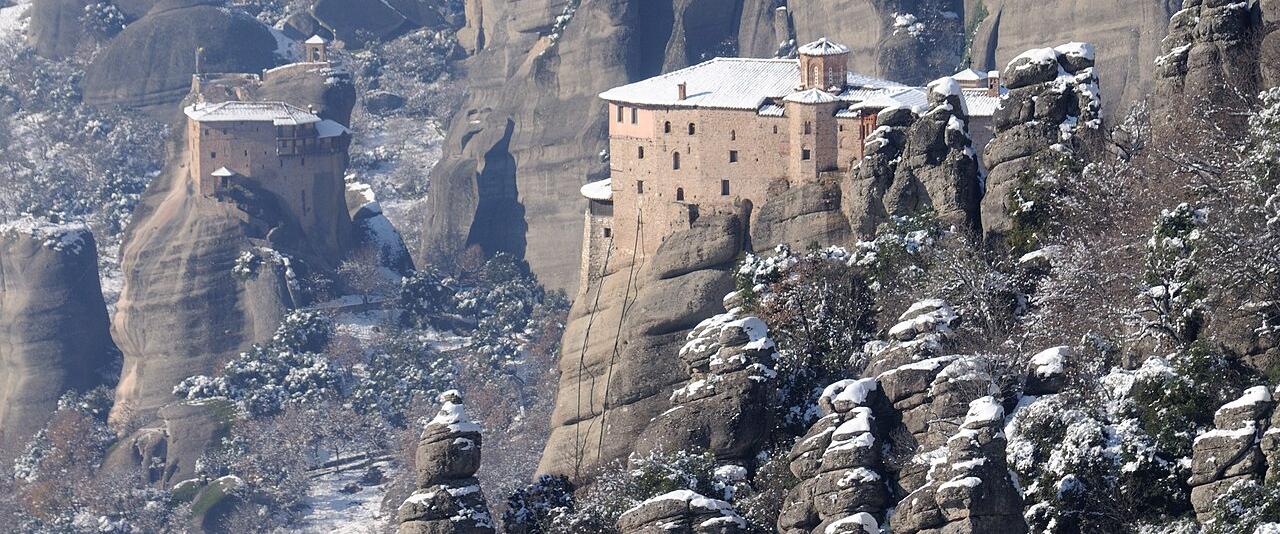
All six Meteora monasteries stay open in winter, but on shorter hours and with more closed days: the winter timetable runs from 1 November to 30 April (to 15 May at Roussanou), and only on Saturdays and Sundays are all six open at once. In winter most of them close between 14:00 and 17:00, and the days they close differ from monastery to monastery. Plan the day around those two facts and you can see every monastery in a day and a half. The hours in this guide come from the Holy Metropolis of Stagoi and Meteora, the diocese that publishes each monastery's timetable.
Winter is the quiet season at Meteora. The tour coaches thin out, the light is low and clear on dry days, and in some years snow settles on the rock pillars above Kalambaka and Kastraki. It is also cold, the days are short and a few roads and paths ice over, so a winter visit needs more planning than a summer one.
Which monasteries are open in winter, and when?
Each monastery sets its own hours, and the Metropolis of Stagoi and Meteora lists them on a summer and a winter timetable. These are the winter hours as published on the Metropolis website in October 2026:
- Great Meteoron (Transfiguration of the Saviour): 09:30 to 14:00. Closed Tuesday, Wednesday and Thursday.
- Varlaam (All Saints): 09:00 to 15:00. Closed Thursday and Friday.
- Roussanou (St Barbara): 10:00 to 14:00. Closed Wednesday. Its winter timetable runs from 1 November to 15 May.
- Holy Trinity: 10:00 to 16:00. Closed Thursday.
- St Stephen: 09:00 to 13:00 and 15:00 to 17:00. Closed Monday.
- St Nicholas Anapafsas: Monday to Thursday 09:00 to 16:00; Saturday and Sunday 09:30 to 14:00. Closed Friday.
Put together, that gives this day-by-day picture for winter:
- Saturday and Sunday: all six open.
- Monday: five open; St Stephen is closed.
- Tuesday: five open; the Great Meteoron is closed.
- Wednesday: four open; the Great Meteoron and Roussanou are closed.
- Thursday: three open (Roussanou, St Stephen, St Nicholas Anapafsas).
- Friday: four open; Varlaam and St Nicholas Anapafsas are closed.
Monks and nuns can change these hours, close for a feast day or a service, or shut a monastery when the weather is bad. Some travel sites still print a winter season that ends on 31 March; the Metropolis timetable says 30 April. Check the Metropolis website (imstagon.gr) or ring the monastery the day before. The Great Meteoron's phone number is +30 24320 22278 and Varlaam's is +30 24320 22277.
The Great Meteoron
The Great Meteoron is the largest and oldest of the Meteora monasteries, on the highest rock in the group. Its church, the katholikon, has well-preserved frescoes, and the monastery also has a small museum, an old kitchen and a cellar. Because it is the best known, it is also the one most likely to be busy, even in winter.
 The Great Meteoron, the largest of the monasteries, with its stairs cut into the rock. Image: DimitrisP67, CC BY-SA 4.0, via Wikimedia Commons.
In winter it is open only four days a week (Friday to Monday), from 09:30 to 14:00. If it is the one monastery you most want to see, build your trip around those days and arrive early. The climb from the road is a long flight of steps, partly cut into the rock, and they can be slippery when wet.
Varlaam
Varlaam stands on the rock next to the Great Meteoron, a few minutes away by road. It is the second-largest monastery and has a well-known fresco cycle, as well as the old winch tower that was once used to haul up people and supplies in a net.
 Varlaam above a snow-covered landscape in January. Image: Josep M. Gracia, CC BY-SA 4.0, via Wikimedia Commons.
In winter Varlaam is open 09:00 to 15:00 and closed on Thursdays and Fridays. Combine it with the Great Meteoron on a Saturday, Sunday or Monday, when both are open.
Roussanou
Roussanou is a convent of nuns, built on a narrow rock and reached by footbridges. It is one of the easier monasteries to reach from the road, which matters in icy weather. In winter it is open 10:00 to 14:00 and closed on Wednesdays; its winter timetable runs until 15 May.
 Roussanou on its rock pillar in winter, with snow on the ledges below. Image: Josep M. Gracia, CC BY-SA 4.0, via Wikimedia Commons.
Holy Trinity
Holy Trinity sits alone on a rock to the east of the main group and is reached on foot by a long stairway and a path from the road. It is one of the more strenuous climbs, so allow extra time and wear shoes with grip if there has been rain or snow. In winter it keeps the longest straight opening hours of the six, 10:00 to 16:00, and closes on Thursdays.
 Holy Trinity's church and bell tower on a clear February day. Image: Sadopaul, CC BY-SA 4.0, via Wikimedia Commons.
St Stephen
St Stephen is a convent at the eastern end of the group, closest to Kalambaka. It is the most accessible of the six: you reach it from the road over a short bridge, without a long climb, which makes it the best choice for anyone with limited mobility or on a day of ice. The views over the Thessaly plain are wide.
 St Stephen at the eastern end of the rocks, above the Thessaly plain. Image: Chabe01, CC BY-SA 4.0, via Wikimedia Commons.
It closes for a midday break: in winter it is open 09:00 to 13:00 and again 15:00 to 17:00, and closed on Mondays. That afternoon session makes it a good last stop of the day, when the other monasteries have already shut.
St Nicholas Anapafsas
St Nicholas Anapafsas is the first monastery you pass on the road up from Kastraki. It is built on a small rock in several narrow storeys, and its church has 16th-century frescoes by the Cretan painter Theophanes. In winter it opens Monday to Thursday from 09:00 to 16:00, and Saturday and Sunday from 09:30 to 14:00. It is closed on Fridays.
 St Nicholas Anapafsas, built in storeys on its rock above Kastraki. Image: Ava Babili, CC BY-SA 4.0, via Wikimedia Commons.
What is the weather like at Meteora in winter?
Expect cold, with frost on clear nights. Kalambaka lies on the edge of the Thessaly plain, under the Pindus mountains, and on winter mornings mist can fill the valley before the sun burns it off. Rain is more common than snow. In some winters, though, snow does fall on the rocks; the photos in this guide were taken in early January 2009.
 Morning mist below the rocks above Kastraki in December. Image: Dimitris Eleftheriou, CC BY-SA 4.0, via Wikimedia Commons.
When it snows, the road that loops past the monasteries can be icy, and a monastery may close for the day. Check the forecast and, after snow, ring ahead. Days are short in December and January, and the monasteries close well before dark, so start early and save the viewpoints for the last of the light.
Getting to Meteora by train from Athens or Thessaloniki
Meteora is reached from Kalambaka, the town at the foot of the rocks. Hellenic Train serves Kalambaka from the main Athens–Thessaloniki line by changing at Palaiofarsalos. At the time of writing, the Palaiofarsalos–Kalambaka section is run with replacement buses rather than trains, and the company's timetable (dated May 2026) shows two connections a day each way:
- Palaiofarsalos to Kalambaka: departs 10:30 and 21:15, arrives 12:30 and 23:15, calling at Sofades, Karditsa and Trikala.
- Kalambaka to Palaiofarsalos: departs 05:45 and 16:50, arrives 07:45 and 18:50.
These connect with Intercity trains on the Athens–Thessaloniki line, so the same change works from either city. Book the through journey on the Hellenic Train website, and check its "Important updates" page before you travel, as timetables and replacement services change.
 Kalambaka station, the end of the line from Palaiofarsalos. Image: Falk2, CC BY-SA 4.0, via Wikimedia Commons.
From Kalambaka, the monasteries are a few kilometres uphill by road. Fit walkers can climb the old footpaths in dry weather; otherwise take a taxi from Kalambaka. Driving gives the most flexibility in winter, as you can move between monasteries to match their opening days.
What to wear: the monastery dress code
The monasteries are working religious communities, and the dress code is enforced at the door. The Metropolis notice says that men may not enter in Bermuda shorts, short trousers or sleeveless tops, and women may not enter in trousers or sleeveless tops. In practice that means a skirt below the knee for women. Some monasteries lend wraparound skirts at the entrance, but it is easier to bring your own.
Winter makes the rest simple: long sleeves are what you will be wearing anyway. Add warm layers, a waterproof, and shoes with good grip for the steps.
Is Meteora crowded in winter?
Much less than in summer. The big tour groups come from spring to autumn. In winter you are more likely to have a chapel to yourself on a weekday morning. The exception is weekends and public holidays, when more Greek visitors arrive, and Christmas, New Year and 6 January (Epiphany). These are also important feast days for the monasteries, with services that may change opening hours.
The trade-off is the closures: on a Thursday in winter only three monasteries are open. If you want to see all six, spend a Saturday or a Sunday at Meteora, or split your visit over two days, for example Monday and Tuesday.
A sample winter day at Meteora
On a Saturday or Sunday, when all six are open:
- 09:00 St Stephen, at the eastern end, as it opens.
- 09:45 Holy Trinity, the longest climb, while you are fresh.
- 11:00 Roussanou (opens 10:00).
- 11:45 Varlaam.
- 12:45 The Great Meteoron, before it closes at 14:00.
- 13:30 St Nicholas Anapafsas, before it closes at 14:00 at weekends.
That is a tight day. Most visitors see three or four monasteries in a day and come back for the rest. Each monastery charges a small entrance fee; carry some cash.
Other things to do nearby in winter
Trikala, on the bus route about 40 minutes before Kalambaka, holds the Mill of the Elves (Mylos ton Xotikon) each Christmas season, in and around the old Matsopoulos mill. For 2026–27 the Municipality of Trikala gives the dates as 20 November 2026 to 6 January 2027, open daily from 10:00 to 22:00, with free entry. The tree is lit on 18 November and the official opening is on 29 November. For the rest of the season, see Christmas and New Year in Greece.
Kastraki, the village directly under the rocks, is a good base and has the closest views of the pillars. The old footpaths between the villages and the monasteries are walkable in dry weather, but they are steep and can be muddy after rain.