- Where
- Olympia, Peloponnese
- Directions
- Directions
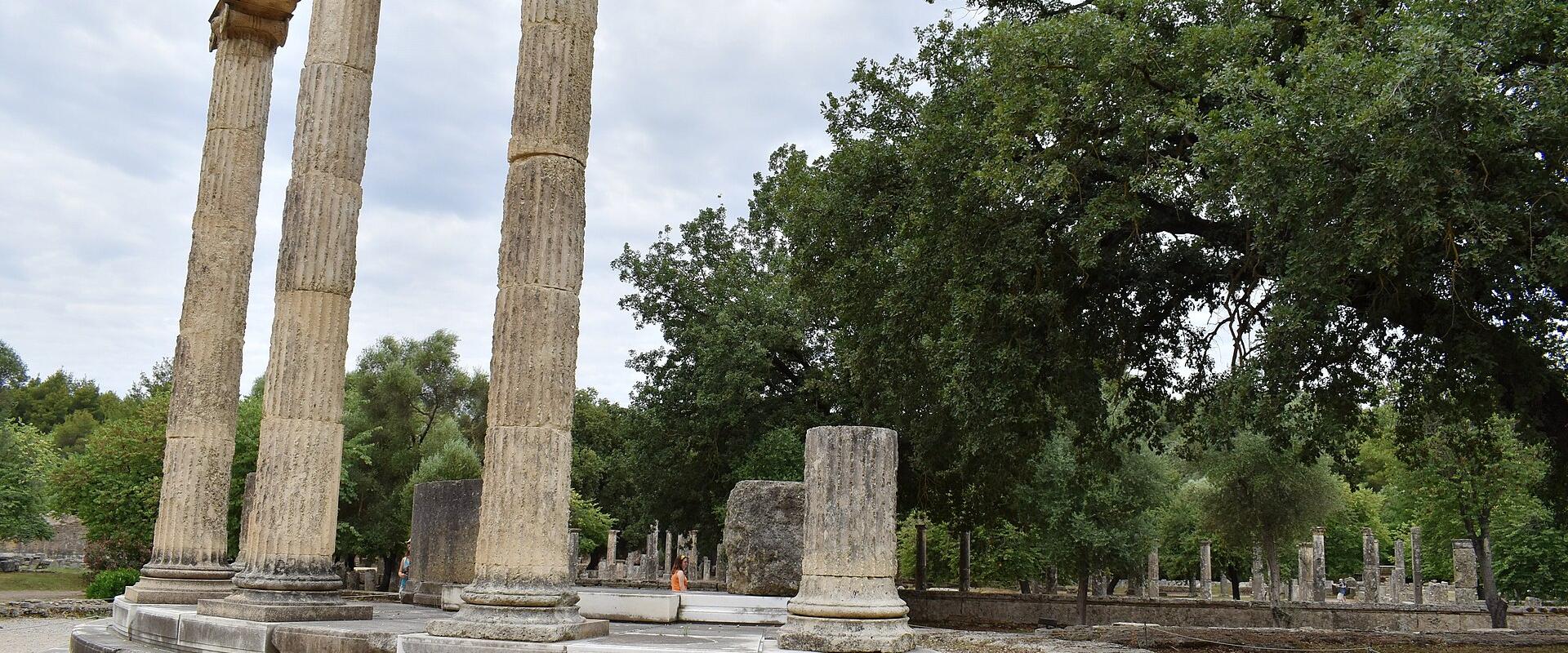
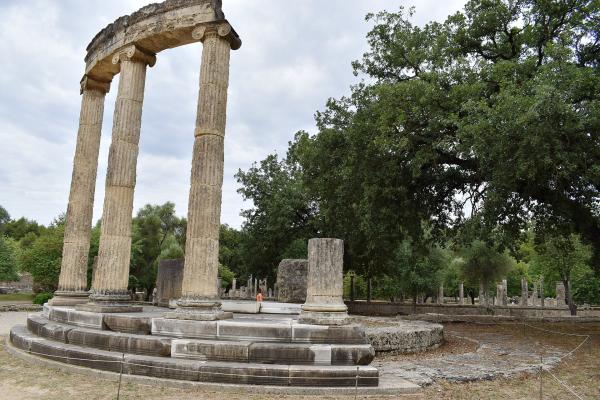
In a sanctuary best known for the Olympic Games, among the temples and treasuries of the sacred precinct of Olympia in the Peloponnese, the Altis, one building stands apart in shape and purpose: the Philippeion, a small round monument built to celebrate a king. Most of the structures in the sanctuary are rectangular, but the Philippeion is a circular building, a tholos, set in the Altis between the Heraion and the Pelopion. It was commissioned by Philip II of Macedon after his victory at Chaeronea in 338 BC, which gave him control of Greece, and it was completed by his son Alexander the Great. It was the only building at Olympia dedicated to a human ruler rather than a god or hero.
The design was elegant. The Philippeion had a ring of eighteen slender Ionic columns around a circular wall, with a roof of marble tiles topped by a bronze poppy. Inside, a semicircular platform held statues of Philip, his father Amyntas, his wife Olympias, his son Alexander and his mother Eurydice. According to ancient writers, the statues were made of gold and ivory by the sculptor Leochares, a leading artist of the day. The building thus combined architecture and portrait sculpture in a single statement of dynastic power, placed in the most sacred part of the sanctuary.
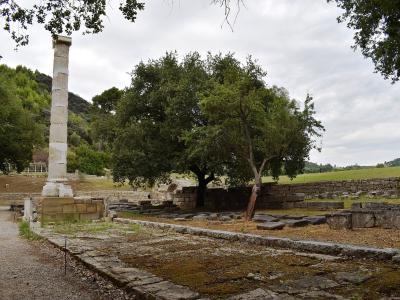
Today the Philippeion is a low circle of foundation stones, with the lowest sections of the walls and the bases of a few columns visible. It takes some imagination to restore the building, but the shape is clear, and information boards show how it looked. The monument lies near the Temple of Hera, so it is easy to include on a walk through the Altis, and it forms a useful contrast to the larger temples. Its presence reflects how, by the fourth century BC, the Macedonian kings saw Olympia as a stage on which to claim leadership of the Greek world.
The sanctuary was administered by the people of Elis, the Eleans, who received guests, officials and victors, and the story of the Philippeion shows the politics around the games as well as the sport. The building survived into Roman times, but was damaged by earthquakes and later buried by river silt and landslides.
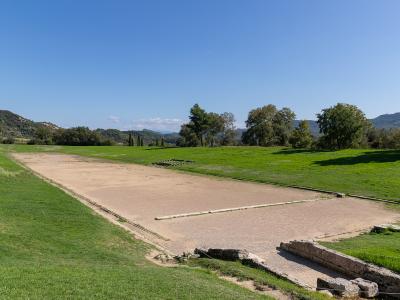
Visitors reach the Philippeion as part of the main archaeological site at Olympia, which has a single entrance and ticket. The route through the Altis passes it after the Temple of Zeus and the Heraion, and the ground is level, with shade from pines. The best light for photographs is in the morning or late afternoon, and a hat and water are useful in summer. The Archaeological Museum has finds from the area, and a visit pairs naturally with the ancient stadium.
Categories
More photos coming soon
Nearby Attractions
Other places to visit in Olympia
Questions people ask
Quick Facts
Best Time to Visit
May through October offers warm, dry weather ideal for exploring the archaeological site.