Why Look Beyond the Caldera Towns
Most visitors to Santorini spend their time along the caldera rim, in Fira, Firostefani, Imerovigli and Oia. These are the views the island is famous for, but they are also where the crowds concentrate, especially at sunset and on days when several cruise ships are anchored below. Santorini is small, about 18 kilometres from north to south, and its inland villages are rarely more than a 20-minute drive from Fira. They show a different side of the island: fortified medieval settlements, vineyards, cave houses and churches, and everyday village life.
Two charges are worth knowing about. Cruise passengers landing on Santorini pay a per-passenger port fee, set at 20 euros from June to September. Hotel and rental guests pay a per-room, per-night climate resilience fee at their accommodation.
Pyrgos
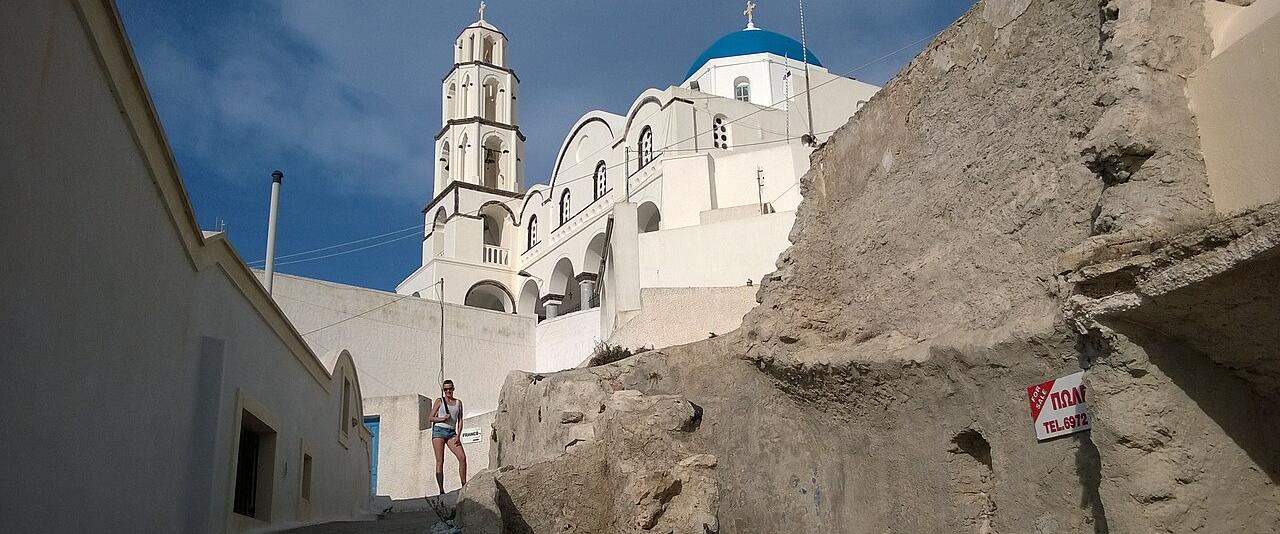
Pyrgos Kallistis, on a hill south-east of Fira, is the highest of Santorini's traditional villages. Its lanes spiral up to the ruins of a Venetian castle, or kasteli, at the top, built for defence against pirates, with houses and churches packed tightly inside the old walls. From the top you can see across the whole island, including both the caldera and the east coast. Pyrgos also has many churches, and its Easter celebrations, when the village is lit with thousands of small flames, are well known in Greece.
Above Pyrgos, a road climbs to Profitis Ilias, the island's highest point at about 567 metres, where a monastery stands next to military installations.
The Southern Villages: Megalochori and Emporio
Megalochori
Megalochori in the south-west is a wine village built around a small square with a distinctive bell tower that arches over a lane. Many of its larger houses were built by wealthy winemakers in the 18th and 19th centuries, and several old canavas (wine cellars) survive. It is a good place to start a winery visit, since several producers are within a short drive. The village is close to the caldera edge, but on the quieter southern part of the island.
Emporio
Emporio (also spelled Emporeio), the largest village on the island, was a trading centre in the past. Its old core, the Kasteli of Emporio, is a fortified settlement where the outer houses form a continuous wall with only a few entrances, an arrangement once used in many Cycladic villages for protection against pirates. Inside, narrow lanes, arches and stairways run between the houses. On the hill above the village stand a row of old windmills and the medieval Goulas tower. Emporio is a working village rather than a resort, which is much of its appeal.
Finikia, Vothonas and the Interior
Finikia, a short walk east of Oia, is the quiet counterpart to its famous neighbour. Its painted houses and narrow lanes are very photogenic, and it has a fraction of Oia's foot traffic. You can combine the two: spend the day in Finikia and walk to Oia only for the evening.
Vothonas, inland near the airport, is built partly into the walls of a ravine, with cave houses dug into the soft volcanic rock. Exo Gonia and Mesa Gonia on the slopes below Pyrgos have large churches, including the blue-domed church of Agios Charalambos, and old wineries. Karterados, just south of Fira, is a mostly residential village with traditional cave houses, within walking distance of Fira.
Wine Country
Santorini's volcanic soil and dry, windy climate produce some of Greece's most distinctive wines. The main white grape is Assyrtiko, a crisp, mineral wine that has become one of Greece's best-known exports. The vines are traditionally trained low into basket shapes called kouloures, which protect the grapes from wind and help them collect moisture. Vinsanto, a sweet wine made from sun-dried grapes, is the island's traditional dessert wine.
Many wineries around Megalochori, Pyrgos, Exo Gonia and Akrotiri offer tastings and tours; booking ahead is sensible in summer.
Akrotiri and the South
At the south-western tip, the prehistoric settlement of Akrotiri is the island's most important archaeological site: a Bronze Age town buried by the volcanic eruption around the 17th century BC, preserved under ash with multi-storey buildings, streets and drains. It is protected by a large roof, so it is comfortable to visit even in summer. Many of its wall paintings are displayed in the Museum of Prehistoric Thera in Fira.
The modern village of Akrotiri has its own Venetian castle ruins, and the Akrotiri lighthouse at the end of the road is a quieter sunset spot than Oia, although it is no longer a secret.
Tips for a Quieter Santorini
- Visit villages in the morning, before cruise passengers arrive, or in the evening once they have left.
- Use the KTEL bus network, centred on Fira, to reach Pyrgos, Megalochori, Emporio and Akrotiri.
- Travel in April, May, October or early November, when the weather is still mild.
- Stay in an inland village such as Pyrgos or Megalochori and visit the caldera towns on day trips.