When Rain Hits Chania
Chania gets most of its rain between November and March, when a run of wet days is normal and the harbour cafes pull their awnings in. Summer storms are rare. If you are in western Crete in the cooler months, it pays to keep a list of indoor options, and Chania has more than most Cretan towns: a large modern archaeological museum, a maritime museum on the harbour, several small collections in Venetian buildings and two house museums in Halepa.
The old town is compact, so you can link two or three of these on foot between showers. The new Archaeological Museum is the exception: it sits east of the centre in Halepa, a short taxi or bus ride or a walk of about half an hour.
Opening hours change between the summer and winter seasons and museums close on some public holidays, so check the current times on the day before you set out.
The Archaeological Museum of Chania
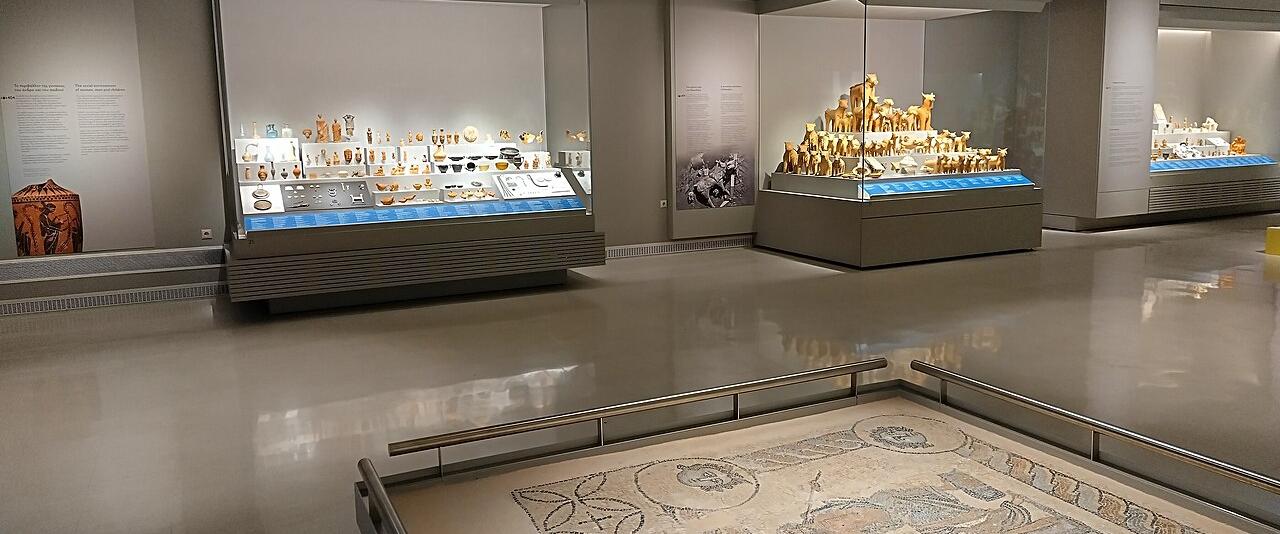
For decades the Archaeological Museum occupied the former Venetian church of San Francesco on Chalidon Street, in the heart of the old town. It closed there in 2020 and reopened in 2022 in a purpose-built building on Skra Street in Halepa. Older guidebooks and maps still send visitors to Chalidon Street, so use the Halepa address.
The collection covers western Crete from the Neolithic period to Roman times, with finds from Kydonia (the ancient city under Chania), Aptera, Lissos, Elyros and other sites. Look for the Late Minoan clay sarcophagi from the Armeni cemetery, inscribed Linear A and Linear B tablets, Roman floor mosaics including one showing Dionysos and Ariadne, and a bust of the emperor Hadrian found at the Diktynnaion sanctuary on the Rodopou peninsula. It is the one museum in Chania that can easily fill a whole morning.
The Maritime Museum and the Minoan Ship
The Maritime Museum of Crete sits at the entrance to the Firkas fortress on the western side of the harbour. Its two floors run in rough chronological order from Bronze Age ship models through a scale model of the Venetian town and harbour to twentieth-century Greek navy vessels. A section covers the Battle of Crete in 1941, and another room holds shells, corals and other marine specimens.
The museum also runs a smaller annex in a Venetian shipyard (neorio) at the eastern end of the harbour. Its centrepiece is a 17-metre experimental replica of a Minoan ship, built in the early 2000s using Bronze Age techniques and later rowed and sailed to Piraeus. Check that the annex is open before walking round, as its hours are more limited than the main museum.
Byzantine, Folk and Fine Art Collections
Three smaller collections are close to each other in the old town:
- Byzantine and Post-Byzantine Collection – in the restored church of San Salvatore near the Firkas fortress. Icons, wall-painting fragments, coins, jewellery and a mosaic floor cover the period from early Christian times to the centuries of Venetian and Ottoman rule.
- Folklore Museum – a private collection reached through the courtyard of the Catholic church on Chalidon Street, with woven textiles, embroidery, tools and reconstructed rooms of a traditional Cretan house.
- Municipal Art Gallery – in a neoclassical building on Chalidon Street, with a permanent collection of modern Greek art, including Cretan painters, and temporary exhibitions.
None of these takes more than an hour, which makes them good fillers when the rain eases and starts again.
Etz Hayyim Synagogue
Etz Hayyim, on a lane off Kondylaki Street in the former Jewish quarter, is the only surviving synagogue on Crete. The building began as a Venetian church and became a synagogue in the seventeenth century. In 1944 Chania's Jewish community was rounded up by the German occupiers; the ship carrying them, the Tanais, was sunk at sea and almost everyone aboard died. The ruined synagogue was restored in the late 1990s and survived two arson attacks in 2010. Today it is a working synagogue and a place of memory that welcomes visitors of any faith, with a quiet courtyard garden and memorial plaques listing the names of the deported. Visiting hours are limited and it closes for Jewish holidays.
Halepa, Venizelos and Other Indoor Options
If you take a taxi to the Archaeological Museum, combine it with Halepa's other sights. The house of Eleftherios Venizelos, the Cretan-born statesman who served as Greek prime minister, is now a museum run by the foundation that bears his name, with rooms furnished as he knew them and exhibits on his political career.
Other options:
- Mosque of the Janissaries on the harbour front, the oldest Ottoman building in Chania, which hosts temporary exhibitions when it is open.
- Museum of Typography in the industrial area at Souda, a short drive east, where old presses, type and printed material trace the history of printing; demonstrations on historic presses are part of the visit.
- Chania Municipal Market (Agora), the cross-shaped covered market of 1913, worth checking for current opening status, as it has been closed for long restoration works.
Planning a Wet-Day Route
A practical sequence for a full rainy day: start at the Archaeological Museum in Halepa when it opens, walk or take a taxi back to the harbour for the Maritime Museum, have lunch in the old town, then pick two of the small collections around Chalidon Street, Etz Hayyim or the Byzantine collection near the Firkas.
Bring a light waterproof rather than an umbrella, because the wind off the harbour turns umbrellas inside out, and wear shoes with grip, since the polished stone lanes of the old town become slippery in the rain.