The harbor in context
Chania, on the north coast of western Crete, was a Venetian city for more than four centuries before the Ottoman conquest in 1645. The old harbor and the town behind it took their present shape under Venice: fortifications begun in 1538 enclosed the old town, and the harbor was protected by a long breakwater. The eastern and western sections of the walls still stand.
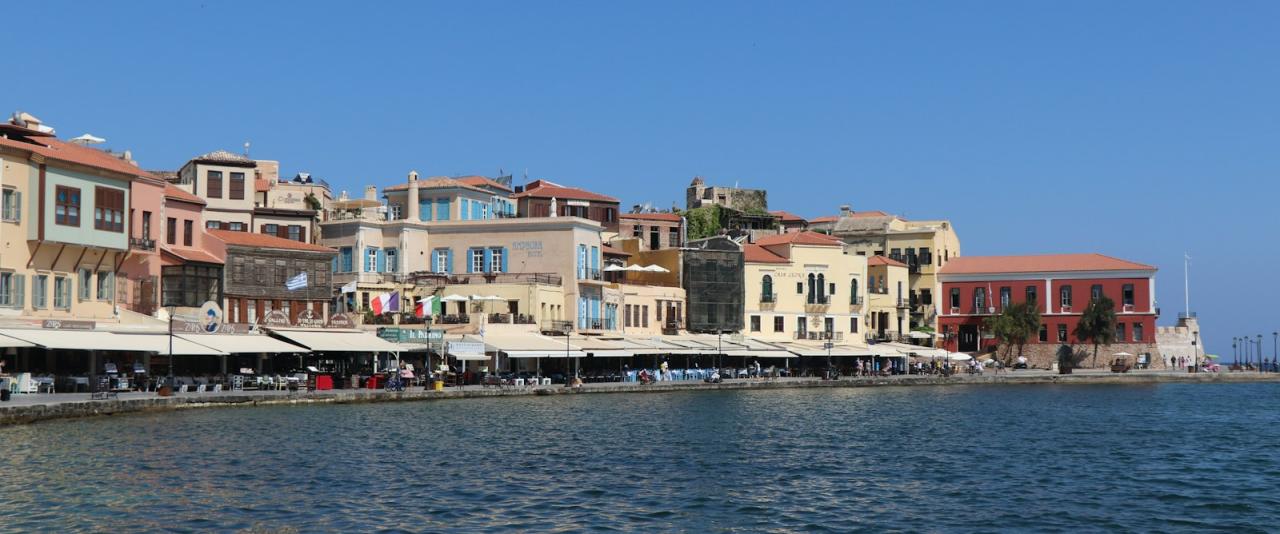
Today the harbor is the centre of Chania's old town. The curved waterfront, lined with restaurants and cafes, runs from the Firkas fortress on the west side to the shipyards on the east. Behind it are the quarters of Topanas, the Jewish quarter (Evraiki), Kastelli and Splantzia.
Along the waterfront
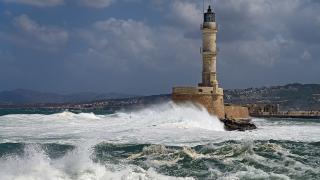
The lighthouse. The lighthouse at the end of the breakwater is the symbol of Chania. Its stone base dates from the Venetian period, at the end of the 16th century; the tower was rebuilt in the 19th century during the period of Egyptian administration of Crete. Sources disagree on the exact date of the rebuild. You can walk out along the breakwater from the eastern side of the harbor for a view back over the town.
The Firkas fortress and Maritime Museum. At the western entrance to the harbor, the Firkas was a Venetian bastion. In 1913 the Greek flag was raised here to mark the union of Crete with Greece, in the presence of Eleftherios Venizelos and King Constantine. Inside is the Maritime Museum of Crete, with models, maps and material on the island's naval history.
The Kucuk Hasan Pasha Mosque. The domed building on the eastern waterfront, also called the Yali Mosque, dates from the early Ottoman period and is the oldest Ottoman building in Crete still standing. It is now used as an exhibition space.
The Venetian shipyards (Neoria). At the eastern end of the harbor, a row of vaulted shipyards survives from a complex begun in the 16th century, where Venetian galleys were built and repaired. Of the original 17 vaults, seven continuous ones survive together, plus a larger restored building further west, the Grand Arsenal, now home to the Centre of Mediterranean Architecture.
Behind the harbor: the old town quarters
Topanas, the western quarter behind the Firkas, takes its name from a Venetian ammunition store. Under Ottoman rule it was the Christian quarter. Its narrow lanes are lined with restored Venetian and Ottoman houses, many now small hotels.
The Jewish quarter, inside the Topanas area, centres on the Etz Hayyim synagogue, restored and reopened after the community was destroyed in 1944.
Kastelli is the low hill above the harbor, inhabited since Neolithic times and the site of ancient Kydonia; excavations of Minoan remains are visible in places.
Splantzia, to the east, is less touristy. Its square is shaded by a large plane tree and overlooked by the Church of Agios Nikolaos, which has both a minaret and a bell tower from its history as a church, mosque and church again.
When to visit
The harbor is pleasant all day, but its character changes. Early morning is quiet, with fishing boats and delivery vans. In summer the waterfront fills with diners from early evening, and the light at sunset falls on the western side of the harbor and the lighthouse. Outside the summer season, many waterfront businesses stay open, as Chania is a working city rather than a resort.
Eating and staying
The restaurants directly on the waterfront charge for the view, and quality varies. Many visitors eat a street or two back, in Splantzia or the lanes of Topanas, where menus are often more local. Accommodation inside the old town is mostly in converted historic houses; rooms facing the harbor can be noisy late at night in summer.
Getting there
- From the airport: Chania International Airport is about 14 km away on the Akrotiri peninsula, with buses and taxis to the town.
- From the port: ferries from Piraeus arrive at Souda, about 7 km east, with buses and taxis into town.
- By bus: the KTEL bus station is within walking distance of the old town, with connections across western Crete, including to Omalos for the Samaria Gorge.
Parking in the old town is very limited; leave a car at the edge and walk in.