What the Samaria Gorge hike involves
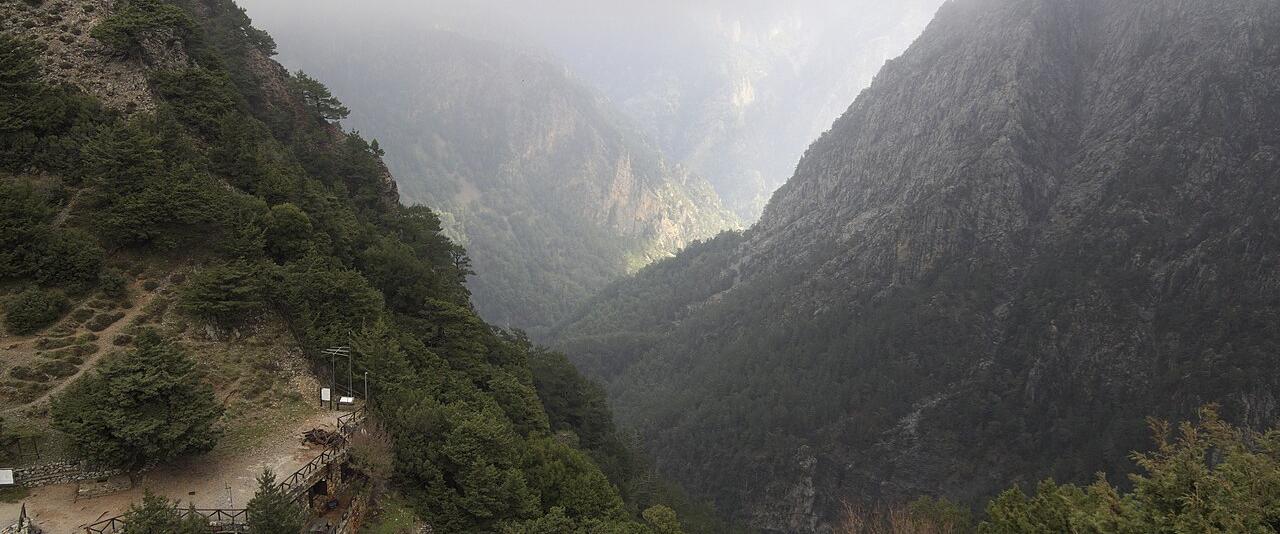
The Samaria Gorge cuts through the White Mountains (Lefka Ori) of western Crete and runs south to the Libyan Sea. The gorge itself is about 16 km long. The walk inside the national park is about 13 km, and the final stretch from the park exit to the village of Agia Roumeli adds roughly 2 km, so most hikers cover around 15 km in total.
The route is one-way and almost entirely downhill. It starts at Xyloskalo, at the edge of the Omalos plateau at roughly 1,200 m, and ends at sea level. Most people take five to seven hours. The first few kilometres descend steeply on a stepped path; after that the trail follows the stream bed over loose stones and small wooden bridges.
The area became a national park in 1962, partly to protect the kri-kri, the Cretan wild goat. The same year the last residents left the village of Samaria, about halfway down. Its restored houses now serve as a rest area and wardens' station.
When the park opens in spring
The park normally opens on 1 May and closes on 31 October. The opening date is not fixed in practice: after a wet winter the stream can run too high to cross safely, and the forest service sometimes delays the opening while the path is checked and repaired. The official ticket portal (samaria-tickets.necca.gov.gr) posts the confirmed date shortly before the season starts, so a hike planned for early May needs a fallback day.
Spring is still a good time to go. The stream carries more water, the plane and cypress trees are in fresh leaf, and the heat that makes the walk hard in July and August has not yet arrived. Mornings at Xyloskalo can be cold even when the coast is warm, so start with a light layer.
Entry is allowed from 07:00 to 15:00. After 15:00 visitors may only walk about 2 km into the park from either end. Camping, overnight stays, lighting fires and swimming in the streams are prohibited.
Tickets and fees
A ticket is mandatory and can be bought online or at the entry points. From May 2025 the standard single-day ticket rose to 10 euros, with reduced rates for groups and families and free entry for under-18s, over-65s and EU students. Check the official portal for the current season's prices before you go, as fees have changed twice in recent years.
Getting to the start and back from the end
The logistics matter more than the walking. Agia Roumeli has no road connection, so the only ways out are by boat or on foot along the coast.
- To Xyloskalo: KTEL buses run early in the morning from Chania to Omalos, timed for the park opening. Morning buses also run from Sougia and Paleochora, though not on Sundays.
- From Agia Roumeli: the afternoon ferry, typically around 17:30, runs east to Chora Sfakion and west to Sougia or Paleochora. Buses back to Chania meet the boats at Chora Sfakion and Sougia.
- Organised day trips: many operators in Chania, Rethymno and Heraklion sell a package that combines the early bus, the boat and the return coach. This removes the timetable risk, at the cost of very early starts from the eastern resorts.
If you drive, the one-way nature of the hike is awkward: you would need to return to Omalos for the car. Taking the bus is usually simpler.
On the trail
The upper section is the most tiring for the knees. Below it the gradient eases and the trail passes through pine and cypress forest before reaching the abandoned village. Further down, the walls close in at the narrowest point, known as the Gates (often called the Iron Gates), where the passage is about 4 m wide and the cliffs rise close to 300 m.
There are rest areas with toilets and springs of drinking water along the route, and wardens are stationed through the gorge. A mule or vehicle evacuation is possible for injuries, but it is slow, so the main safety rule is simple: do not start if you doubt you can walk 15 km downhill on uneven stone.
What to bring
- Hiking shoes or sturdy trainers with good grip; the stones in the stream bed are smooth and loose.
- A refillable bottle; the springs along the route make carrying several litres unnecessary.
- Food for the day, sun protection and a light layer for the cold start.
- Swimwear for the beach at Agia Roumeli while you wait for the boat.
- Cash for the ferry and for food in Agia Roumeli in case card machines are down.
Alternatives if the park is closed
If the gorge has not yet opened, or the weather turns, there are shorter gorges nearby. The Imbros Gorge near Chora Sfakion is a popular half-day walk, and Agia Irini, north of Sougia, offers a quieter forested route. Check access and conditions locally, as these also depend on rainfall.